
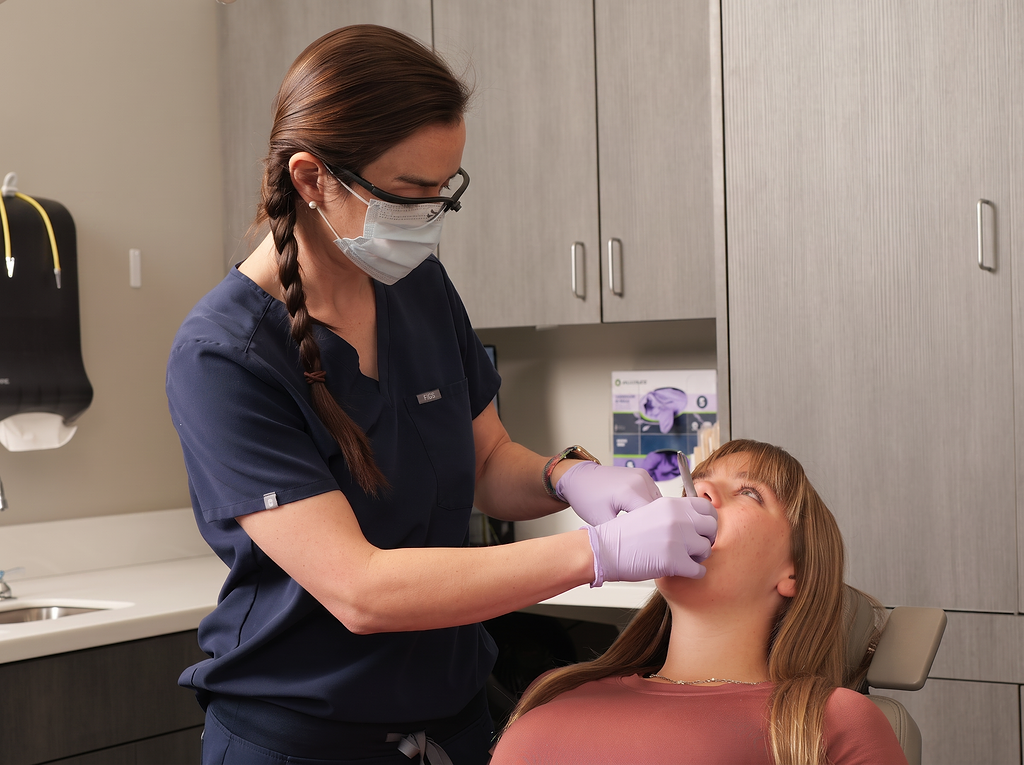
Releasing a Restrictive Frenum to Improve Function
A frenum is a band of tissue that connects the lip or the tongue to nearby structures. When a frenum is unusually tight, it can limit tongue movement, interfere with orthodontic treatment, or affect other oral function.
A lingual frenum connects the underside of the tongue to the floor of the mouth. A labial frenum connects the inside of the upper or lower lip to the gum tissue.
Dr. Amber Hurley Johnson performs both lingual and labial frenectomy procedures.

Lingual Frenectomy
A tight lingual frenum, sometimes called a tongue-tie, can limit how far and how freely the tongue moves. Treatment is considered when the restriction meaningfully affects function and releasing it is expected to improve movement.
Lingual frenectomy is performed in our office by Dr. Johnson.

Labial Frenectomy
A prominent or tightly attached labial frenum can pull on the gum tissue, keep a space open between the front teeth during orthodontic treatment, or interfere with a denture or other restoration.
Dr. Eleni Kanasi, our periodontist, also performs labial frenectomy, particularly when the concern involves gum recession or tension on the gumline.

Coordinated Care
Frenectomy treatment may be coordinated with your general dentist, orthodontist, periodontist, speech-language pathologist, or another provider depending on the reason for referral.
For orthodontic patients, the timing may be before, during, or after orthodontic treatment based on the orthodontist’s plan. For speech concerns, evaluation with a speech-language pathologist may be important before or after surgery.
Speech and Tongue Mobility
A lingual frenectomy does not by itself correct a speech disorder.
The purpose of the procedure is to release the restrictive tissue and improve how the tongue moves. Better range of motion may allow speech exercises or therapy to work more effectively when speech treatment is needed.
Speech improvement depends on the underlying speech pattern, the patient’s age, the anatomy, and participation in therapy when appropriate.

Potential Risks
Potential risks include pain, bleeding, swelling, infection, scarring, reattachment, incomplete improvement in movement, altered sensation, and the possibility that additional therapy or treatment may be needed.
The Procedure
After the area is numbed with local anesthesia, the restrictive tissue is surgically released and repositioned as needed. Sutures may be placed depending on the location and extent of treatment. The technique depends on the location and anatomy of the frenum. For some patients, particularly younger children or those with significant anxiety, sedation options may be discussed.
Recovery and Tongue Mobility Exercises
Mild soreness, swelling, tightness, and temporary sensitivity are common. After a lingual frenectomy, tongue mobility exercises are an important part of recovery. They help maintain the range of motion gained during surgery while the area heals and reduce the chance of scarring, reattachment, and a return of limited movement. Please follow the specific exercise instructions provided for the recommended period. Surgery alone may not produce lasting improvement if the exercises are not done.
Frequently Asked Questions
Not by itself. A lingual frenectomy improves tongue movement. When restricted movement contributes to a speech concern, the improved range of motion may allow speech exercises or therapy to work more effectively.
Yes. After a lingual frenectomy, mobility exercises are a key part of keeping the range of motion gained in surgery and reducing the risk of scarring, reattachment, and a return of restriction. Dr. Johnson will provide instructions on which exercises to do and for how long.
Schedule an Appointment
Most frenectomies are performed on young children, but they can be done at any age. To learn more about this procedure or to schedule a consultation with one of our oral surgery specialists, contact Stafford Oral Surgery & Specialists today.